Multi-Tenor Etude #6: “Double Crossed”


Here is a visually exciting tenor solo from The Art of Multi-Tenor Drumming. The book contains 33 multi-tenor etudes, and this is etude #6 entitled “Double Crossed.” As the title suggests, the focus is on developing crossovers.

Here are the performance notes from the book:

This flashy etude utilizes an abundance of crossovers. The first half begins with an 8th note pattern. The second half, beginning with measure 16, utilizes the same pattern with doubles on every note. Both halves feature a repeated section—the first time through at mezzo-forte, the second time at fortissimo. Be careful not to play the mezzo-forte section too loudly; otherwise the contrast will be obscured, or you will be forced to overplay the fortissimo section. Stark dynamic contrast will really help to sell the ideas in this solo. There is a more intricate 16th note sweep section during the last two lines. Take care to aim for the proper beating spots to avoid rims. You may want to review the 16th note doubles section in the rudimental exercises [contained in the book].

Thanks for watching. If you enjoy the video, please “like” it and share it with your friends!
Multi-Tenor Etude #7: “The Fool in the Mirror”


Bit by bit, I am posting videos of the etudes from my book The Art of Multi-Tenor Drumming. This is multi-tenor etude #7 entitled “The Fool in the Mirror.” Its main theme is pretty catchy, and it focuses on developing 16th note patterns around the drums.

Here are the performance notes from the book:

There is nothing in this etude exceptionally flashy from a visual standpoint, but the melody is quite catchy, and this is one of my favorite etudes to play in this book. (Of course, I think all of the etudes are great!) The whole piece gradually moves from playful syncopated rhythms to more intense driving rhythms, but it returns to a light-hearted note at the very end. The first section (mm. 1-5) establishes the playful syncopated main theme. The second section (mm. 6-9) contrasts the first with a slightly less syncopated 8th note double stop quasi-groove pattern. The third section (mm. 10-13) is a more driving segue that reiterates the main ideas of the first section. The fourth section (mm. 14-19) is the longest (with repeats), and it is the most driving; it has very little syncopation, and it focuses on some basic paradiddle patterns mixed with doubles and 16th note singles rhythms. The final section (mm. 20-22) is the shortest, and it caps off everything by quickly highlighting the previous themes.

Enjoy the video!

Three Ways to Use Tempo When Practicing Music


Struggling with speed, accuracy, or pulse?  James describes three ways you can use different tempos to maximize your practice sessions. The following is a transcript of the video above (slightly reworded for readability):


***************************

Hello, everyone.  This is James Christian with RudimentalUniversity.com. Today I would like to talk about three different ways you can use tempo to help you when practicing a piece of music.

I’ve been thinking about this topic for a while, and this last week several ideas came together.  I Read more “Three Ways to Use Tempo When Practicing Music”

Multi-Tenor Etude #27: “Maze”


Here is the next installment of videos from my book The Art of Multi-Tenor Drumming.  In addition to thousands of exercises, the book contains 33 etudes.  This is etude #27 entitled “Maze.”

Here are the performance notes from the book:

This etude is dedicated to DCI snare champion, Ken Mazur. His books have done a lot to help me grow in my playing, and they were a great inspiration to me in writing this book. The etudes in this section were largely inspired by the “Rudimental Performance” etudes in his orange book [The Basic Technique of Rudimental Drumming]. In fact, this etude can be played as a duet with the final “Rudimental Performance” etude, or it can be played as a stand-alone solo. If played as a duet, the first two measures are a solo introduction, and the snare part would come in on measure 3. I have always loved the snare etude, and I thought it would be nice to have a tenor version of it. (With the added arounds and sweep patterns, the tenor part is slightly more difficult, but you have to be a pretty good player to play either version well.)

In adapting this etude to tenors, I looked to the Marty Hurley/Lee Hansen snare/tenor duets, such as Phantom of the Phield and Phantom Phrenzy. Of course, Ken Mazur was a student of Marty Hurley, and you can hear Hurley’s influence in Mazur’s writing. The Hurley solos were originally written as stand-alone solos. Later, Lee Hansen (another student of Hurley’s) wrote tenor accompaniments that could be played as either a stand-alone tenor solo or a duet with the snare part. These solos were all written for quads (four drums), and I decided to do the same here.

As you play through this etude, you will find that the structure has a really good sense of momentum, and a lot of different rudiments are incorporated. It’s a lot of fun to play, and there are several rudimental surprises throughout. Whether you play it as an individual solo or as a duet with a good snare drummer, it should thoroughly engage any audience.

I hope you enjoy the video!

Multi-Tenor Etude #11: “Believe It or Not”


At the beginning of the year, I announced that I intended to record a number of the etudes from my book The Art of Multi-Tenor Drumming.  There are 33 etudes total, and here is my first video toward that goal.  This is etude #11 entitled “Believe It or Not.”

Here are the performance notes from the book:

This lively etude is intended to be a good overview of fundamental skills. The initial theme is presented in the introduction and hinted at throughout the rest of the solo. Each subsequent section works on a specific skill—movement patterns, triplet rolls, crossovers, flams, odd-metered time signatures, tuplets, extended 32nd note rolls, and extended 24th note singles. Finally, the original theme is reprised, concluding with a final challenge of rapid fire dynamic changes. All of this is packed into 34 energetic measures. Younger players should take this at a moderate tempo, as it will serve as a good solo for incorporating fundamental techniques. More advanced players will find it a challenge to take a more lively tempo. The etude works well at a variety of tempos.

I hope you enjoy the video!

2-Mallet Keyboard Exercise: Singles Speed Builder

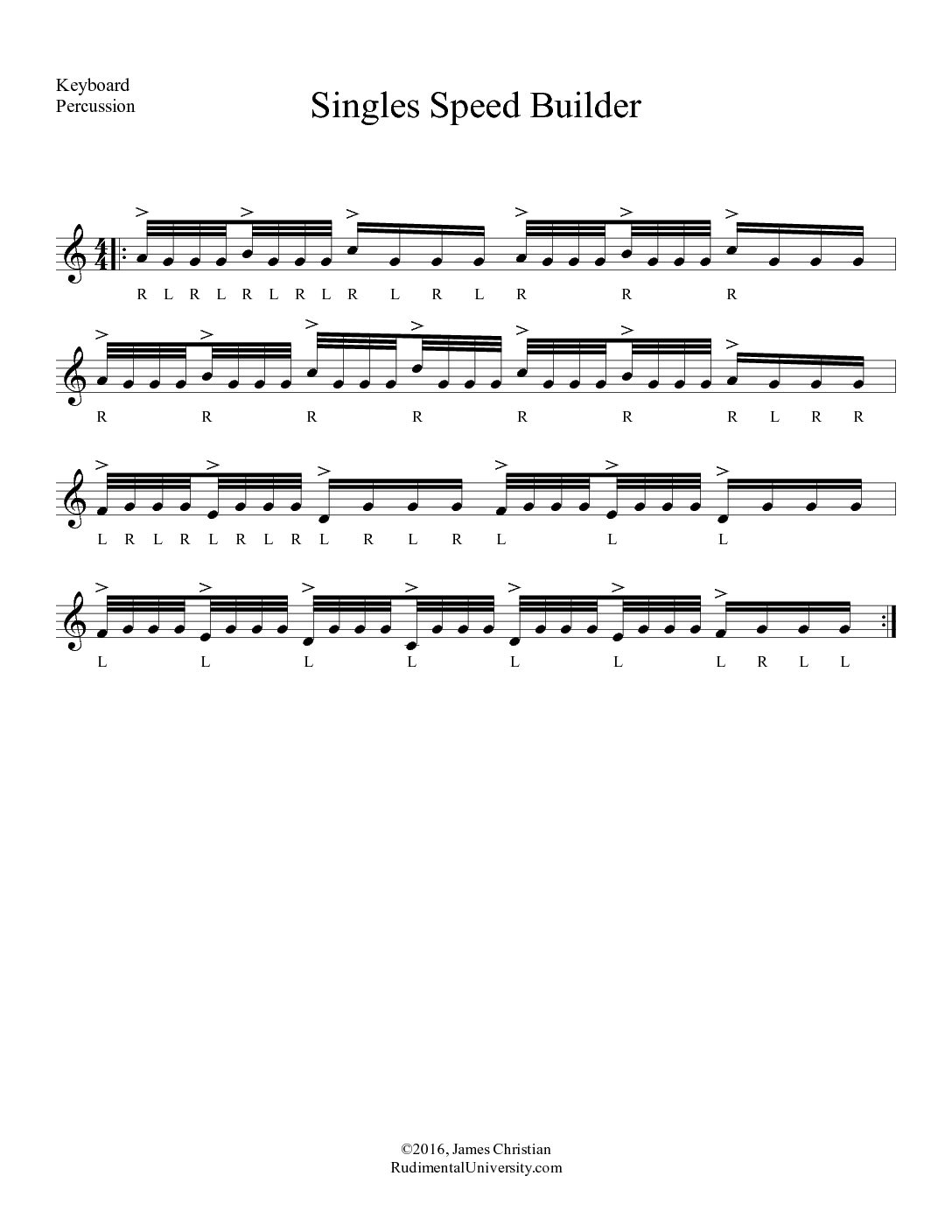
Click on the image to enlarge or click here to download in PDF format.


This short exercise is a good chop builder for keyboard percussion.  It focuses on short spurts (which builds speed), and its length allows for numerous repetitions (which builds endurance).  I came up with this exercise several years ago when I was trying to help a student build their two-mallet speed.  I didn’t expect it to be so popular, but my students have enjoyed playing it ever since.  It’s fairly catchy, and the simplicity of its structure makes it easy to learn.  I have seen firsthand that the students who practice it regularly achieve good results.

When first learning this exercise, take it slowly until you can strike each note with 100% accuracy.  It is short enough to memorize fairly easily.  Remember that the key to speed is staying relaxed!  Of course, you have to push your muscles in order to build endurance, but you must push them with good technique.  Don’t let the speed create a sense of uncontrolled frenzy.  Don’t lock your arms or wrists.  Stay relaxed, yet keep your sound intensely focused.  Strive for consistent strokes, so that you achieve clean execution and articulation.

Enjoy playing!  I hope you notice significant improvement in your singles quality and speed.

Multi-Tenors Exercise: Helicopters, Butterflies, & Figure Eights

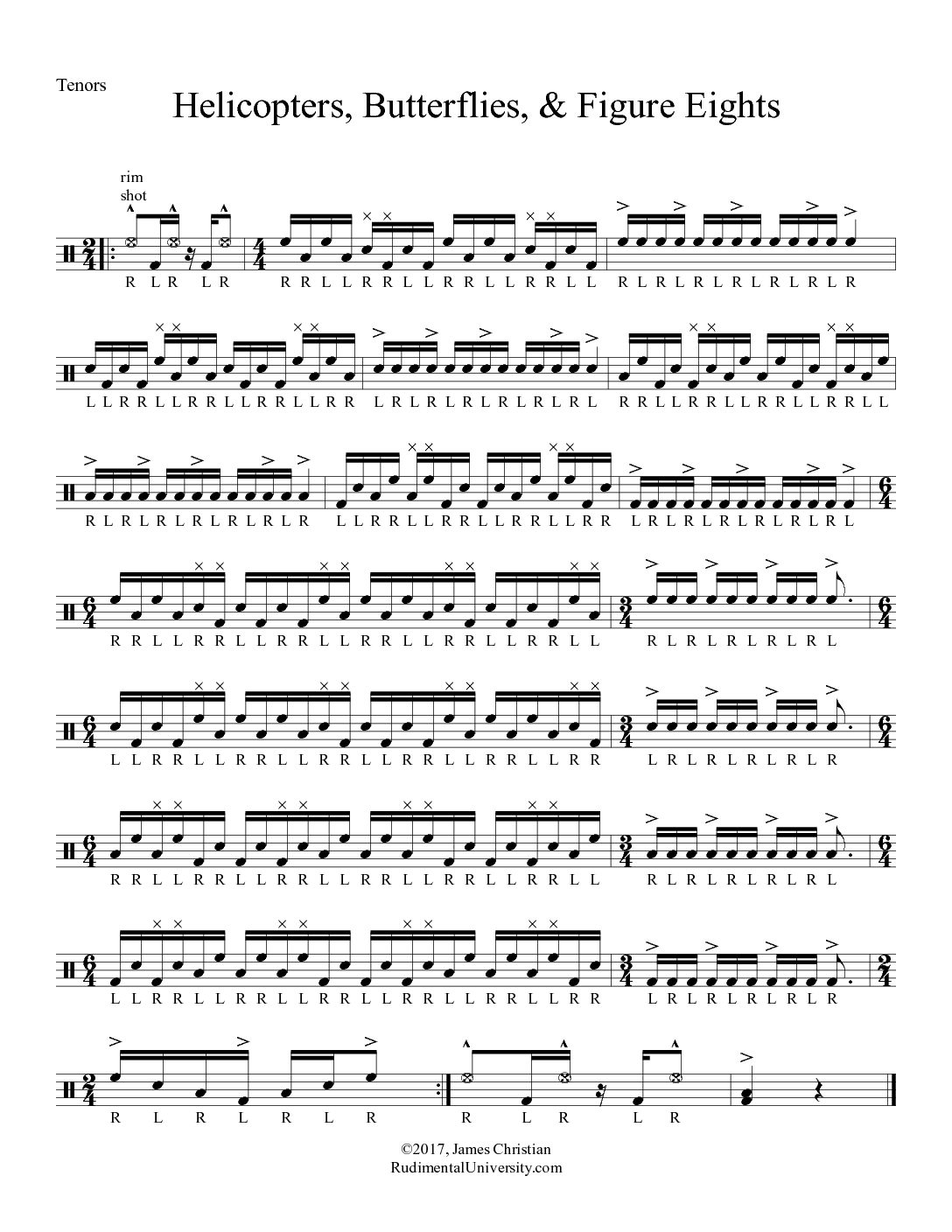
Click on the image to enlarge or click here to download in PDF format.

Here is a new exercise for marching tenors that focuses on the three most common crossover sweep patterns:  helicopters, butterflies, and figure eights.

In case you are unfamiliar with these terms, helicopters are found in measures 2 and 4.  Butterflies are found in measures 6 and 8.  Figure eights are found in measures 10 and 12.  The final pattern, found in measures 14 and 16, is not as common, but it makes logical sense in the context of this exercise.  I call the pattern inward figure eights.  With all of these patterns, they are presented first with right hand lead and then with left hand lead.

All these sweep patterns are based on the visual “picture” created from their movement when played rapidly.  Helicopters look a bit like helicopter blades moving.  Butterflies create sort of a butterfly wing shape.  Figure eights create an “8” shape.  Inward figure eights follow the same motion, but the sweeps move inward instead of outward.

The measures that do not contain sweeps are meant as a groovy check pattern.  I find the accent and rim shot patterns more fun to play than a measure of straight singles (or something similarly basic).  I suspect most readers will enjoy them more as well.

This exercise is great for all ability levels.  Beginner players will want to take each measure very slowly in order to learn these patterns.  You may need to start around 80 beat per minute (bpm) on the metronome.  Advanced players may be able to treat the exercise in more of a double time fashion, playing in a tempo range of 240 bpm—or faster!

As always, focus on proper playing zones.  Avoid rim clicks and aim for 100% accuracy.  Maintain even sounding doubles, so that both notes are of equal volume.  Enjoy!

How to Play 24th Notes, 40th Notes, and More!


Do you know how to count 24th notes, 40th notes, or 48th notes? James walks you through some terminology that may just revolutionize your understanding of rhythm.  The following is a modified transcript of the video above:


***************************

Hello, everybody. This is James Christian with RudimentalUniversity.com.

Today I want to talk about rhythm terminology. Most musicians don’t frequently deal with this particular concept I’m going to discuss, but drummers and percussionists deal with it all the time.

We’re used to whole notes, half notes, quarter, notes, 8th notes, 16th notes, etc.  And we also have tuplet patterns, such as half note triplets, quarter note triplets, 8th note triplets, 16th note triplets, and so forth. In this article, I’m going to talk about the way we discuss tuplet patterns and how we can make it a little bit easier.

This method is especially easier when you’re writing on the Internet and typing.  It also makes your terminology more consistent, regardless of the type of note you’re discussing. When you’re writing, this method will save space, and it’s just a nice shorthand for your terminology.

So here it is… Read more “How to Play 24th Notes, 40th Notes, and More!”

Crash Cymbals Exercise: 12 Bucks

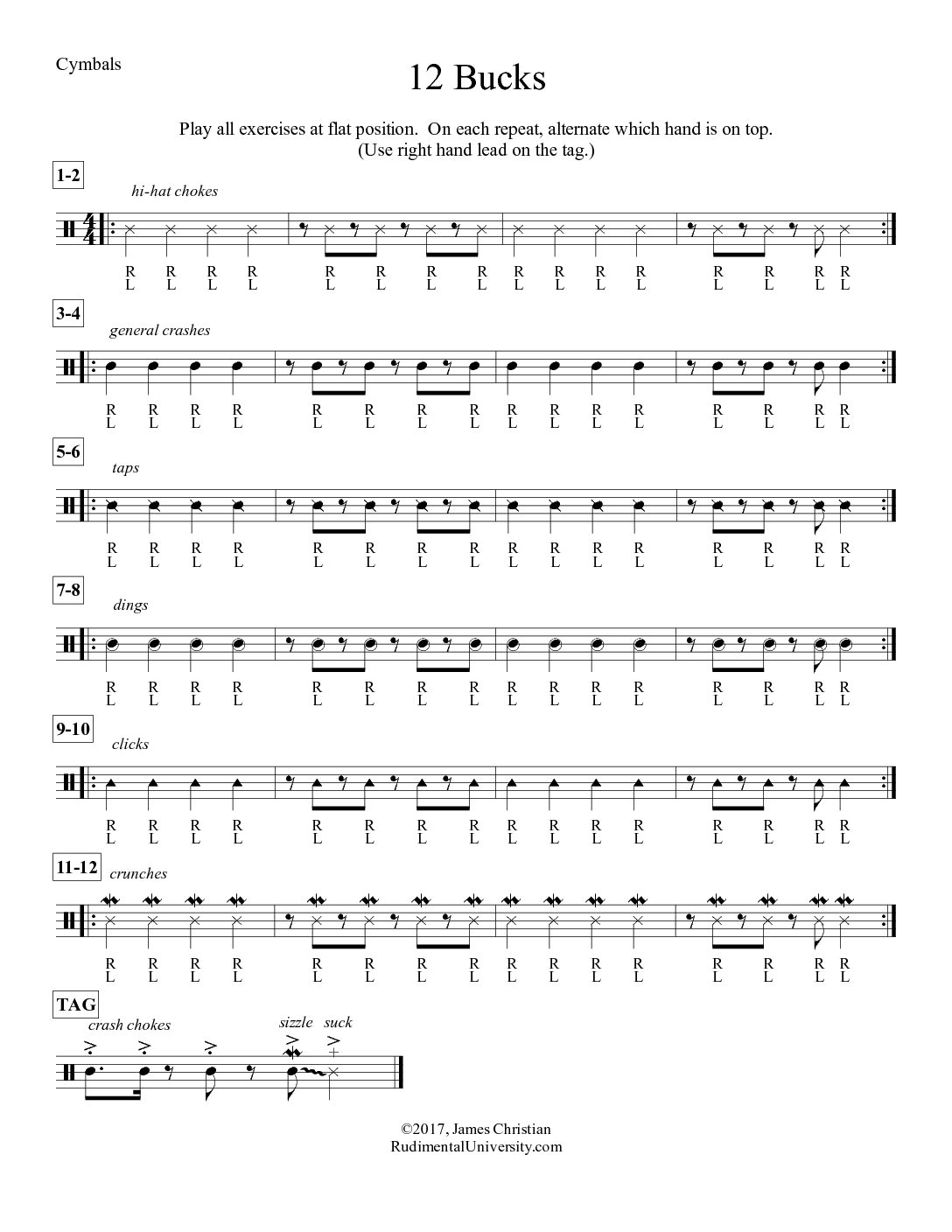
Click on the image to enlarge or click here to download in PDF format.

Today marks the first crash cymbals exercise on Rudimental University!  In just one exercise, the player cycles through a variety of techniques.  This is a really good warm-up for working through some of the most common cymbal effects.  As with all the “12 Bucks” exercises this week, this exercise can be played in individual practice, and it can also be played with other percussionists on other instruments.

The exercise is divided into 12 sections comprised of six “pairs” (1-2, 3-4, 5-6, etc.).  The first time through each section, play with the right hand on top.  On the repeat, flip the cymbals so that the left hand is on top.  Many cymbal players and cymbal lines do not work both hands evenly, but I ask… Why not?  When both hands are equally strong, you have many more options when it comes to performances.

The same rhythmic structure is used throughout the exercise (except for the “tag” at the end).  If you are unfamiliar with extended crash cymbal techniques, there are a few resources online that explain them quite well.  Unfortunately, the terminology varies wildly from instructor to instructor.  I did come across the Oregon Crusaders’ cymbal line packet, and the techniques are all explained quite well in it: http://oregoncrusaders.org/wp-content/uploads/2015/02/OCP-Cymbal-Technique-Book-20151.pdf  (Note: what they call “smashes” are what I call “crunches.”  Everything else is the same.)

Here is the breakdown of the techniques:

  • Sections 1-2:  Hi-hat chokes
  • Sections 3-4:  General crashes (you can either push the top cymbal in a downward motion or away from your body—your choice)
  • Sections 5-6:  Taps
  • Sections 7-8:  Dings
  • Sections 9-10:  Clicks
  • Sections 11-12:  Crunches (a.k.a. Smashes)

The tag utilizes crash chokes and sizzle-sucks.

I personally find this a fun exercise to play.  It provides good audio/visual variety, and it keeps you on your toes.  Happy crashing!

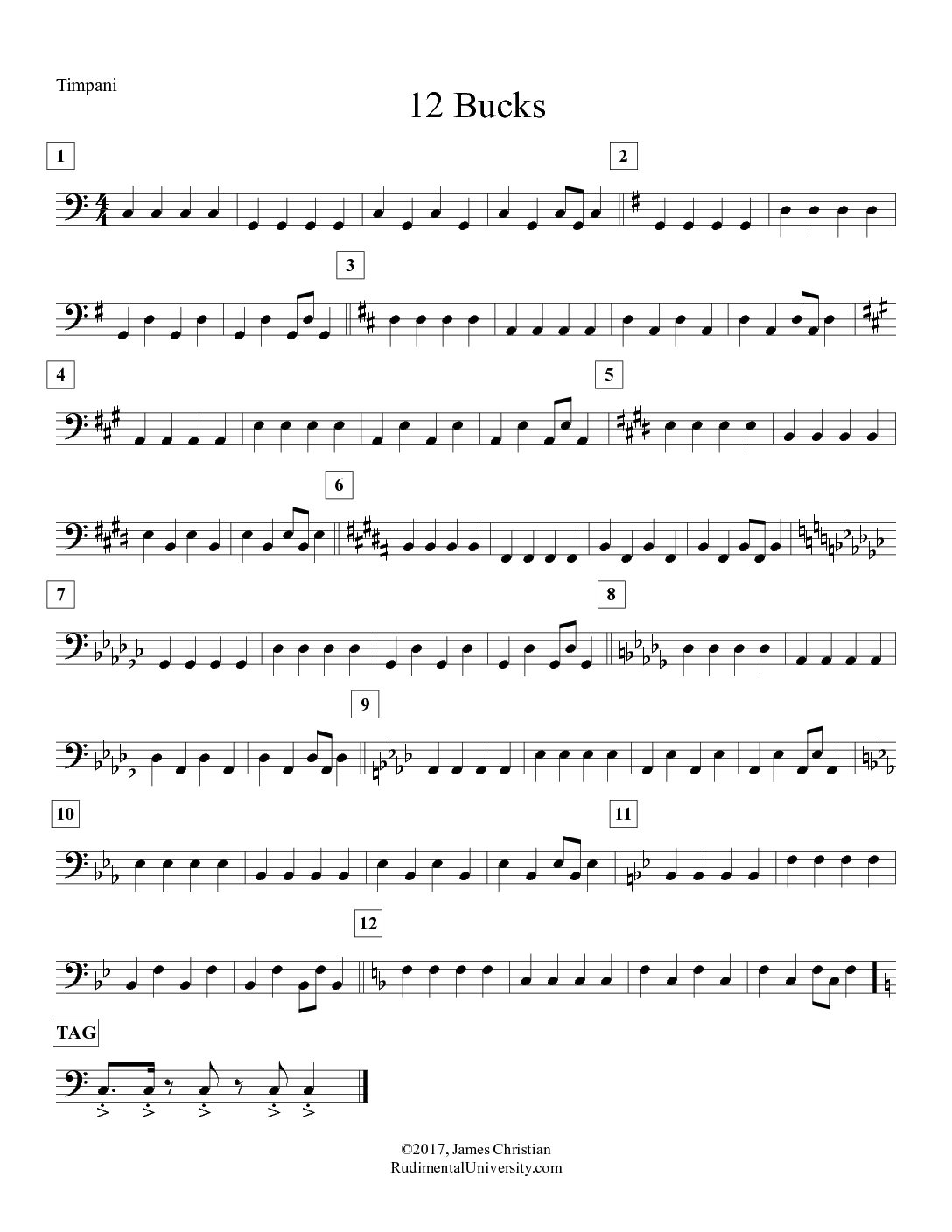
Timpani Exercise: 12 Bucks

Click on the image to enlarge or click here to download in PDF format.

This exercise is a good warm-up for practicing tone quality and pedaling changes.  It goes through the circle of fifths, and each section incorporates the tonic and dominant of the key.  Like the other “12 Bucks” exercises this week, today’s timpani exercise can be played individually or with a group of percussionists.

This exercise can be played on three drums, but four will be easier.  The rhythms are not overly difficult, so it’s a good opportunity to focus on drawing a full tone from the drum on every stroke.  When playing with a group, you may want to use a medium hard mallet to produce slightly sharper articulation.

The main challenge on this exercise will be the pitch changes.  Gauges will certainly make the changes easier, but a well-trained timpanist can learn to “feel” the next pitch as he or she becomes more familiar with the specific set of drums used.  As always, use your ear and learn to adjust quickly, whether you have gauges or not.

Happy pedaling!