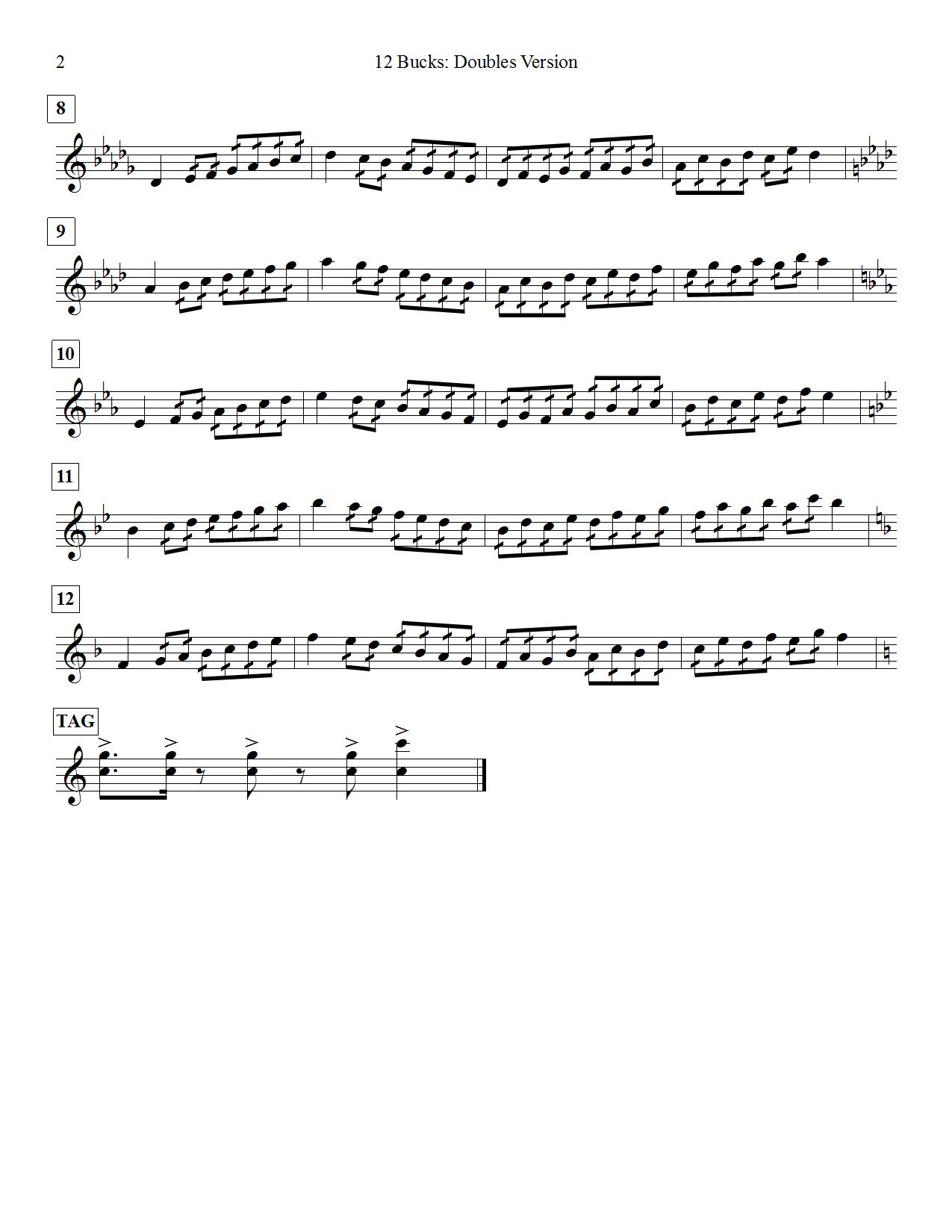
2-Mallet Keyboard Exercise: 12 Bucks (two versions!)

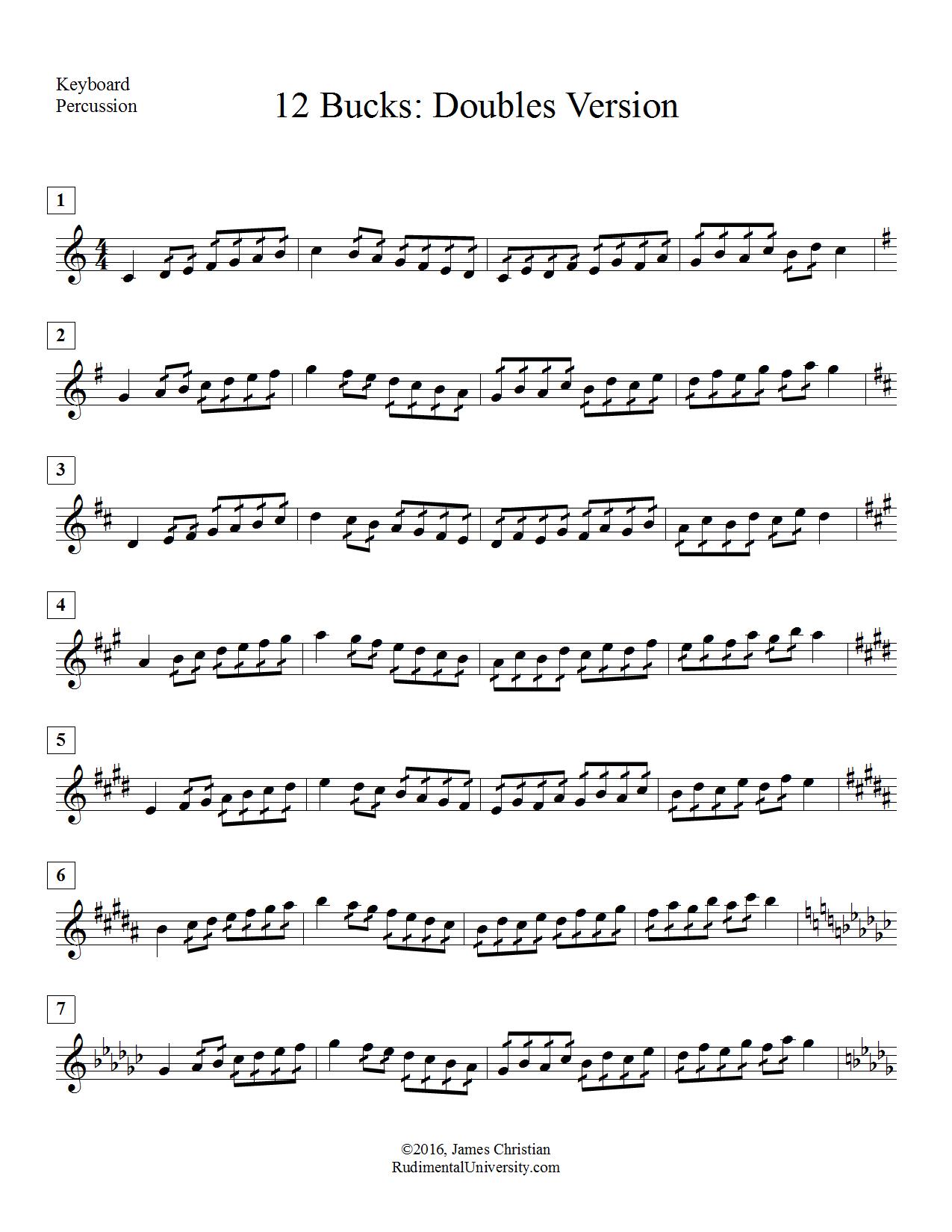
Doubles Version

Click on the images to enlarge…
…or click here to download in PDF format.


Singles Version

Click on the images to enlarge…
…or click here to download in PDF format.


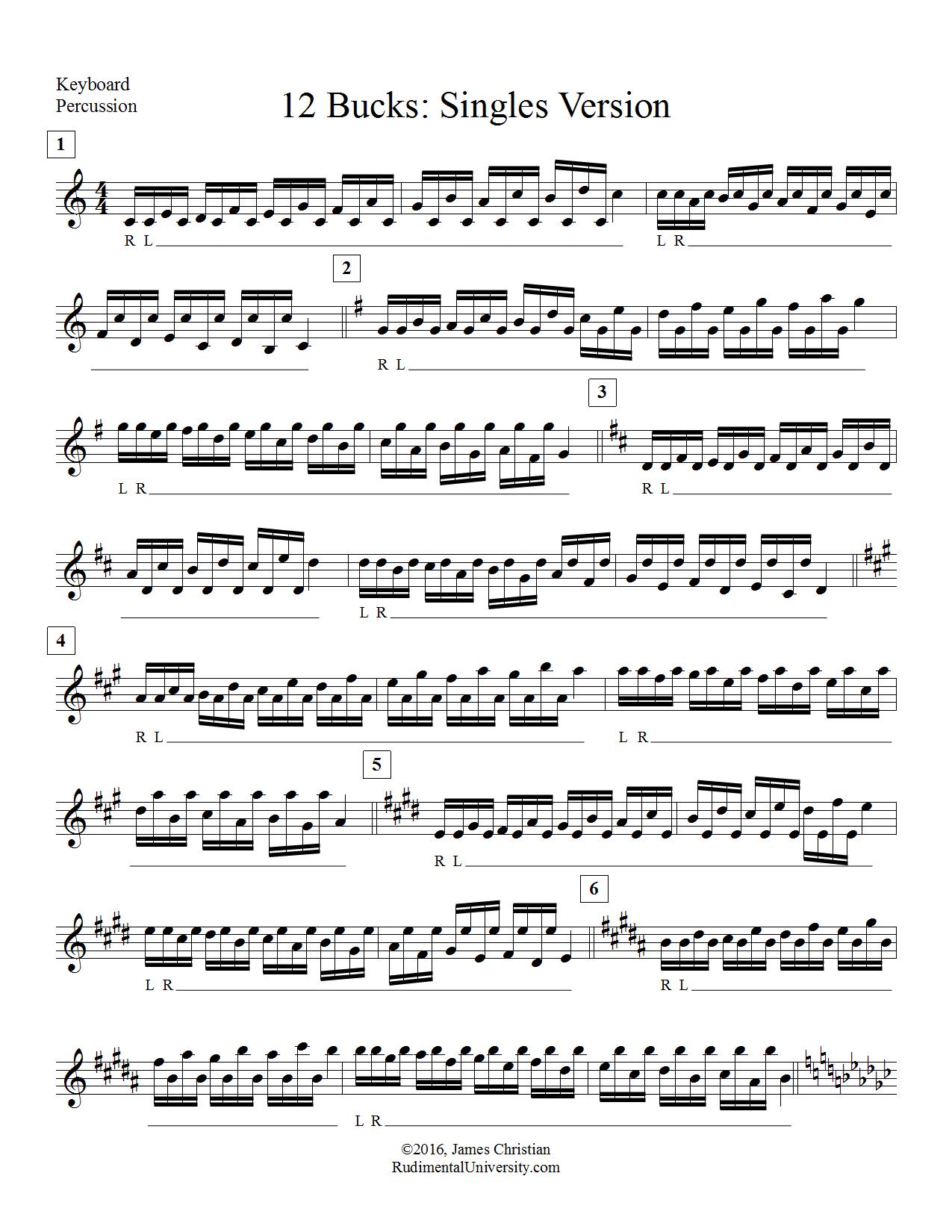
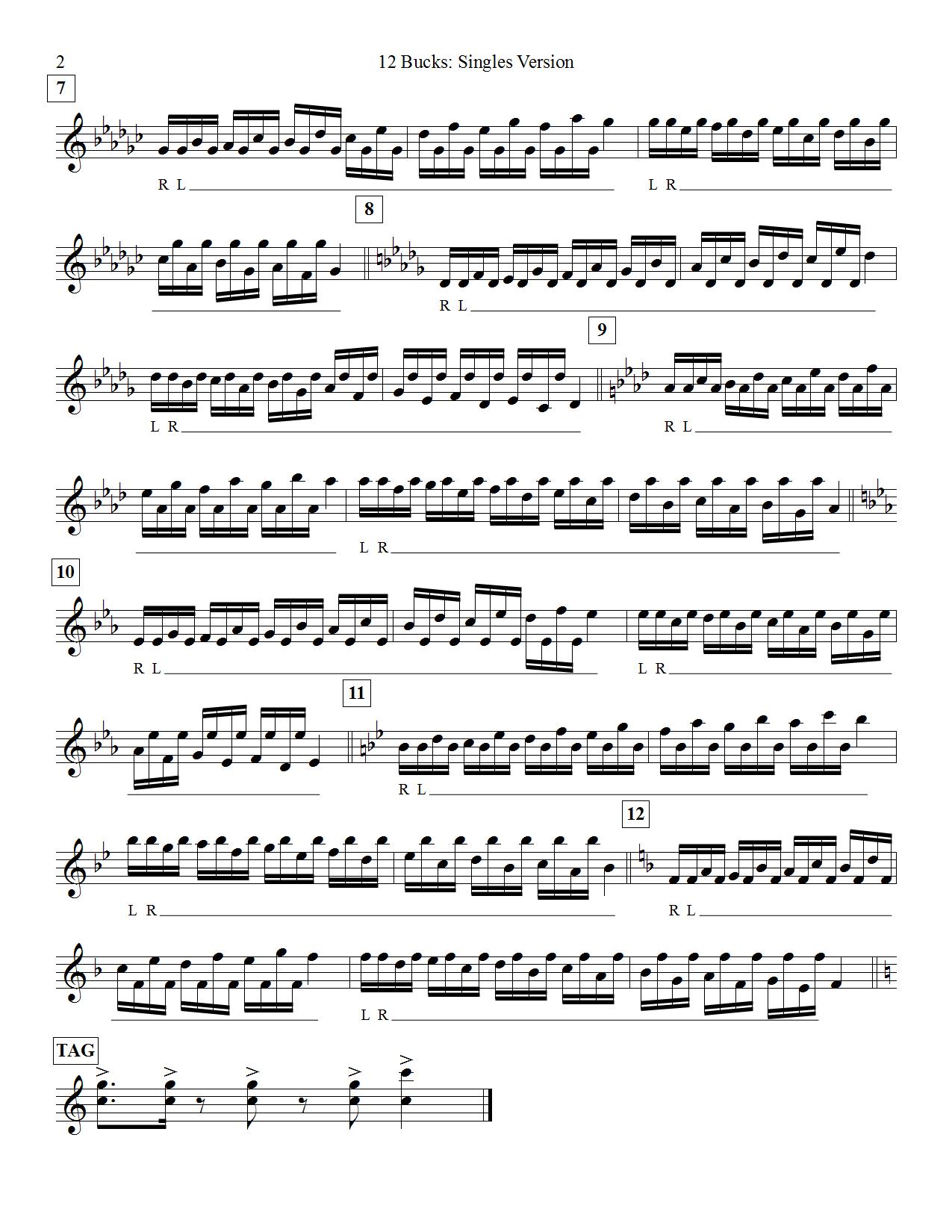
Today you get a double dose of exercises!  Both versions cycle through the circle of fifths and utilize a thirds pattern, but the first version uses double strokes, and the second version uses single strokes.  Both are valuable to learn, and both work important skills.

As mentioned a few days ago, all the exercises this week can be played individually or together as a full drum line.  The snare part is similar to the common “Bucks” exercise, and the keyboard part cycles through 12 keys. Thus the exercise is called “12 Bucks.”

If you don’t know your scales and/or the circle of fifths very well, the main challenge on this exercise will be to switch between keys so quickly.  I would recommend starting with the doubles version.  You can initially learn it without the double strokes, and the technical demands will be slightly easier.  It really is a great exercise for helping you know the circle of fifths intimately.

Once you get the notes down, you can add in the doubles.  Then you can learn the slightly more challenging singles version.  When playing doubles, make sure both notes are of equal volume.  (Don’t “drop” the second note of the doubles.)  When playing singles, make sure you don’t add accents when they aren’t written.  With everything you play, work toward smooth, evenly spaced notes.

For more seasoned players, you may want to take the same exercises and play them with natural minor, harmonic minor, melodic minor, and/or other scale combinations.

Enjoy!
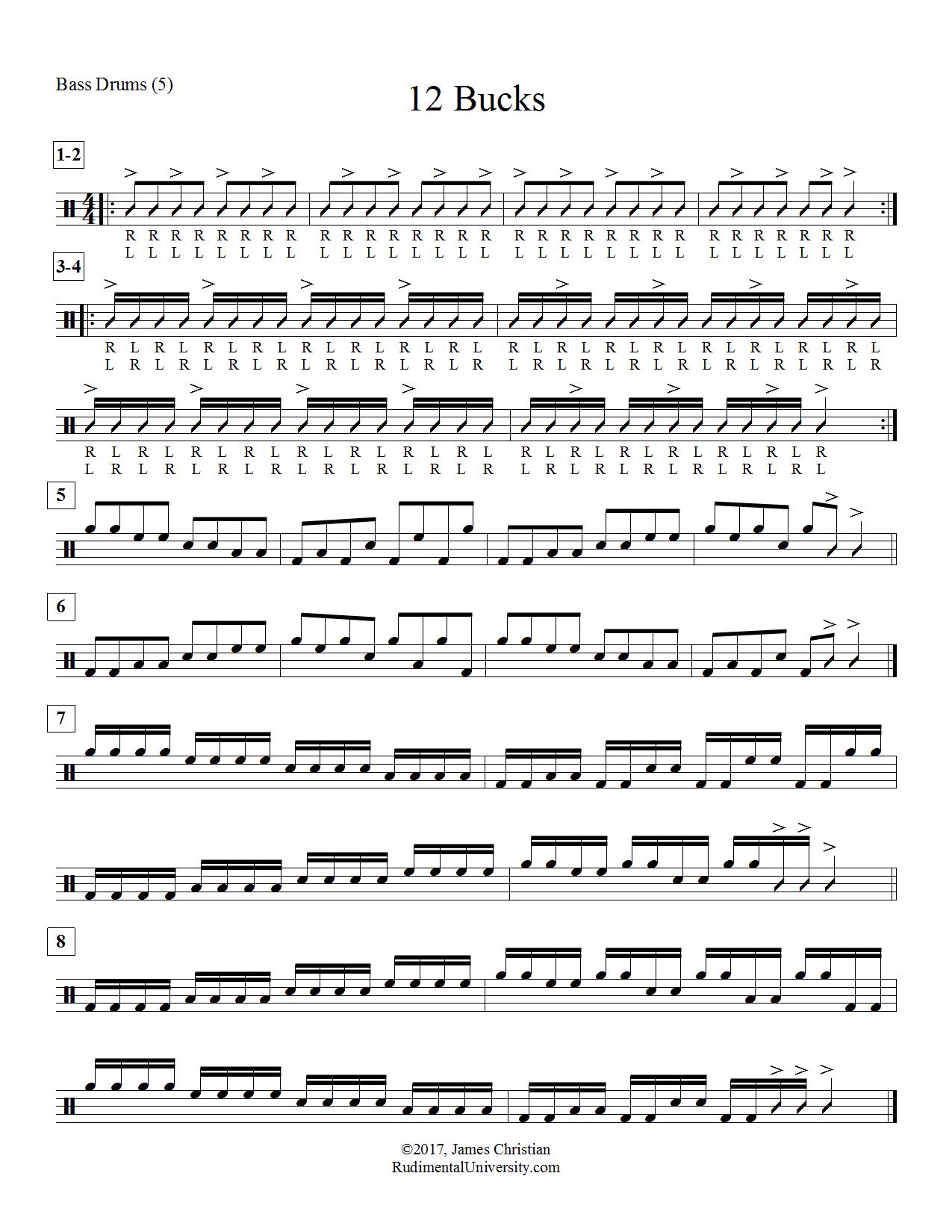
Bass Drum Splitting Exercise: 12 Bucks

Click on the image to enlarge…
…or click here to download in PDF format.


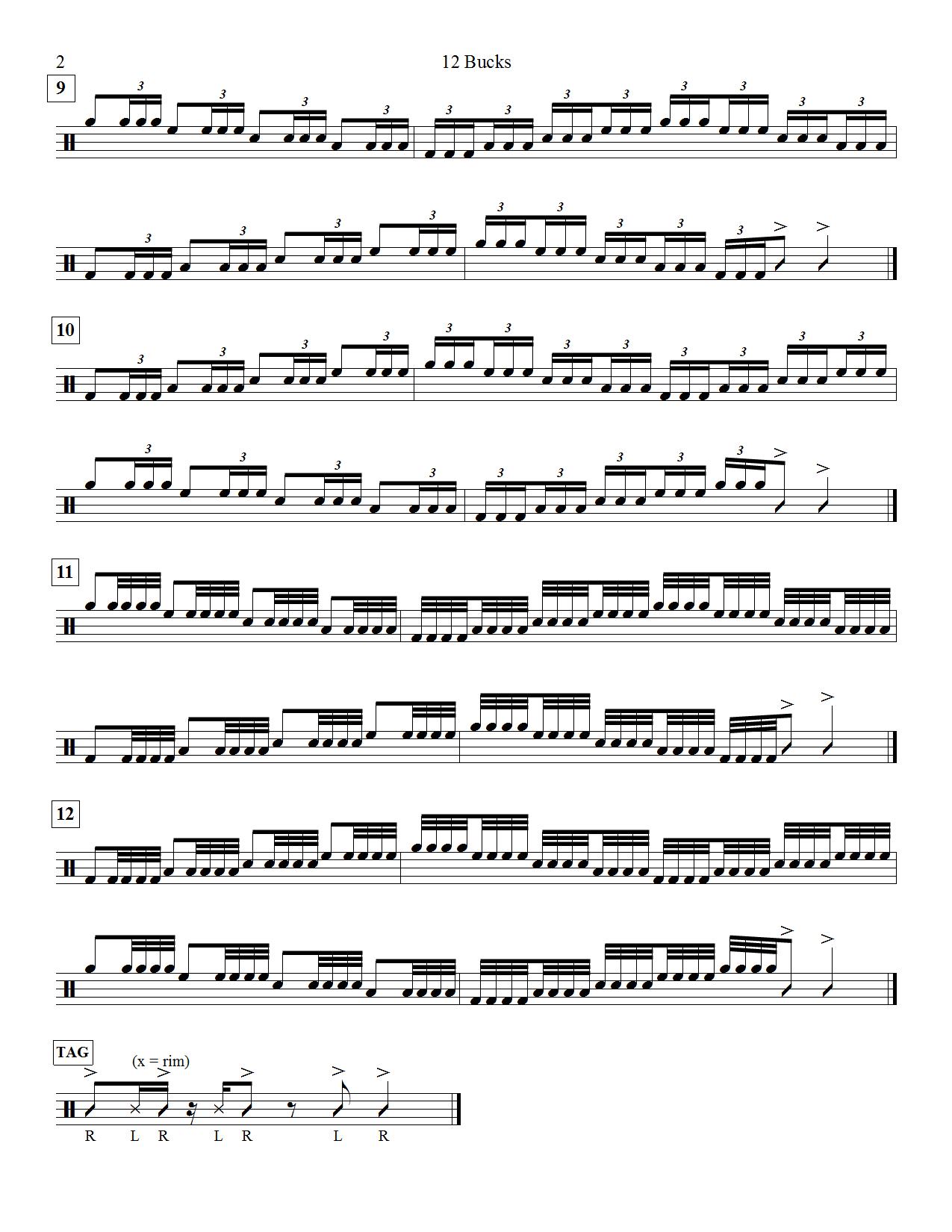
This fun bass exercise can be played with the snare and tenor exercises posted yesterday, or it can stand alone as a good splitting workout for five players.  As the title indicates, there are 12 sections, and each has a specific focus:

  • Sections 1-2:  Unison one-handed accented 8th notes.  Focus on maintaining a clear distinction between accents and taps.  Keep your taps controlled and close to the drum.  Make sure your accents are strong, not wimpy.  Matching stick heights and angles will help in staying together.
  • Sections 3-4:  Unison alternating accented 16th notes.  This should follow the exact same technique as sections 1-2, except the opposite hand is now “filling in” the 16th notes.  All taps should be consistently at the same height and volume.  Keep the accents strong and the taps consistently softer.
  • Sections 5-6:  Split 8th note patterns.  Focus on precise note placing.  Mentally subdividing the beat is essential.
  • Sections 7-8:  Split 16th note patterns.  Make sure the 16th notes are placed exactly in time, so that the transitions from player to player are smooth.
  • Sections 9-10:  Split 16th note triplet patterns.  Once again, take care to maintain precise note spacing.  Be careful not to “crush” or “stretch” the triplets.
  • Sections 11-12:  Split 32nd note patterns.  As the note speed increases, technique becomes even more important.  Maintain control without becoming rigid.  Stay relaxed without becoming sloppy.  Take care to achieve clarity on every single note.

Happy splitting!

Snare & Multi-Tenors Exercise: 12 Bucks

Snare Drum

Click on the image to enlarge or click here to download in PDF format.

Multi-Tenor Drums
Click on the image to enlarge…
…or click here to download in PDF format.

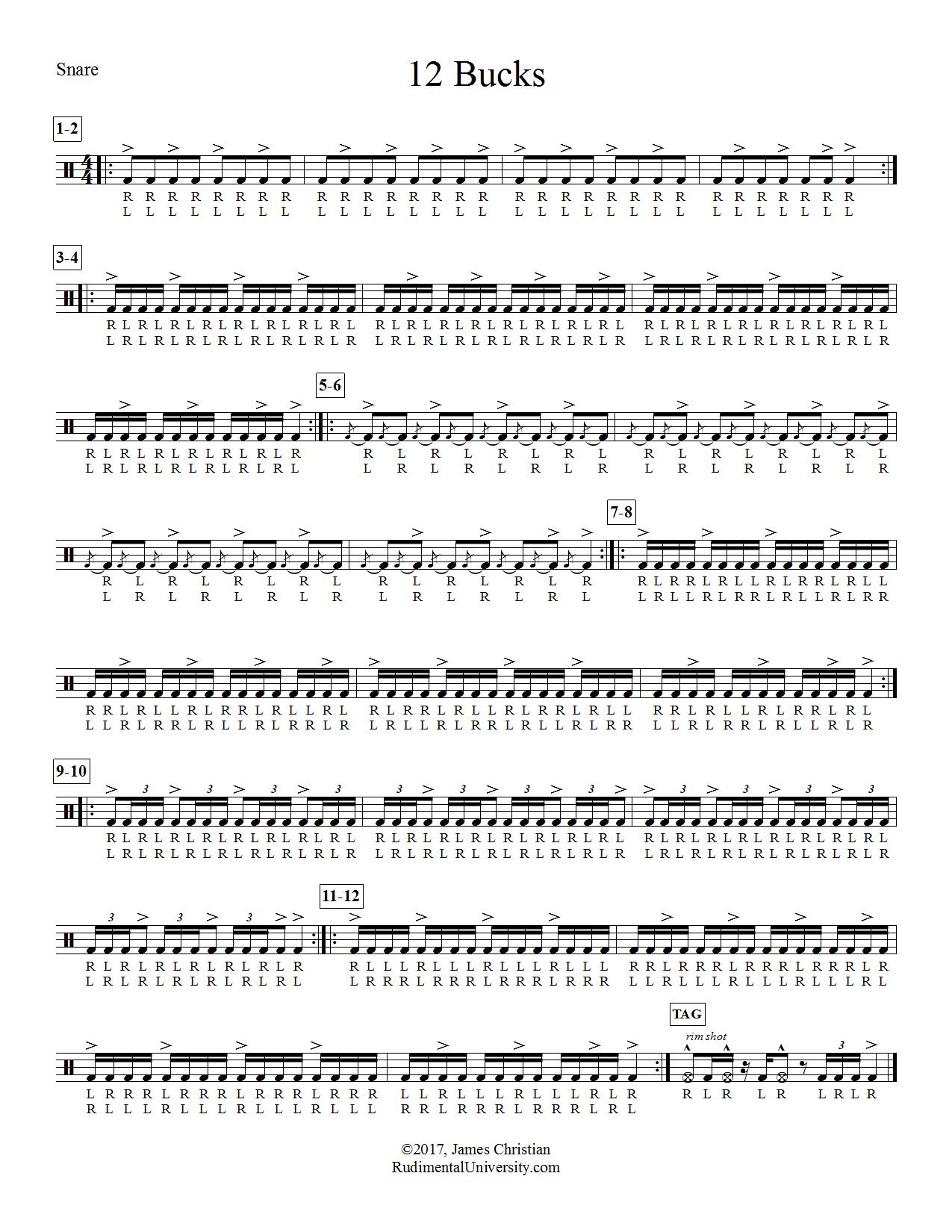
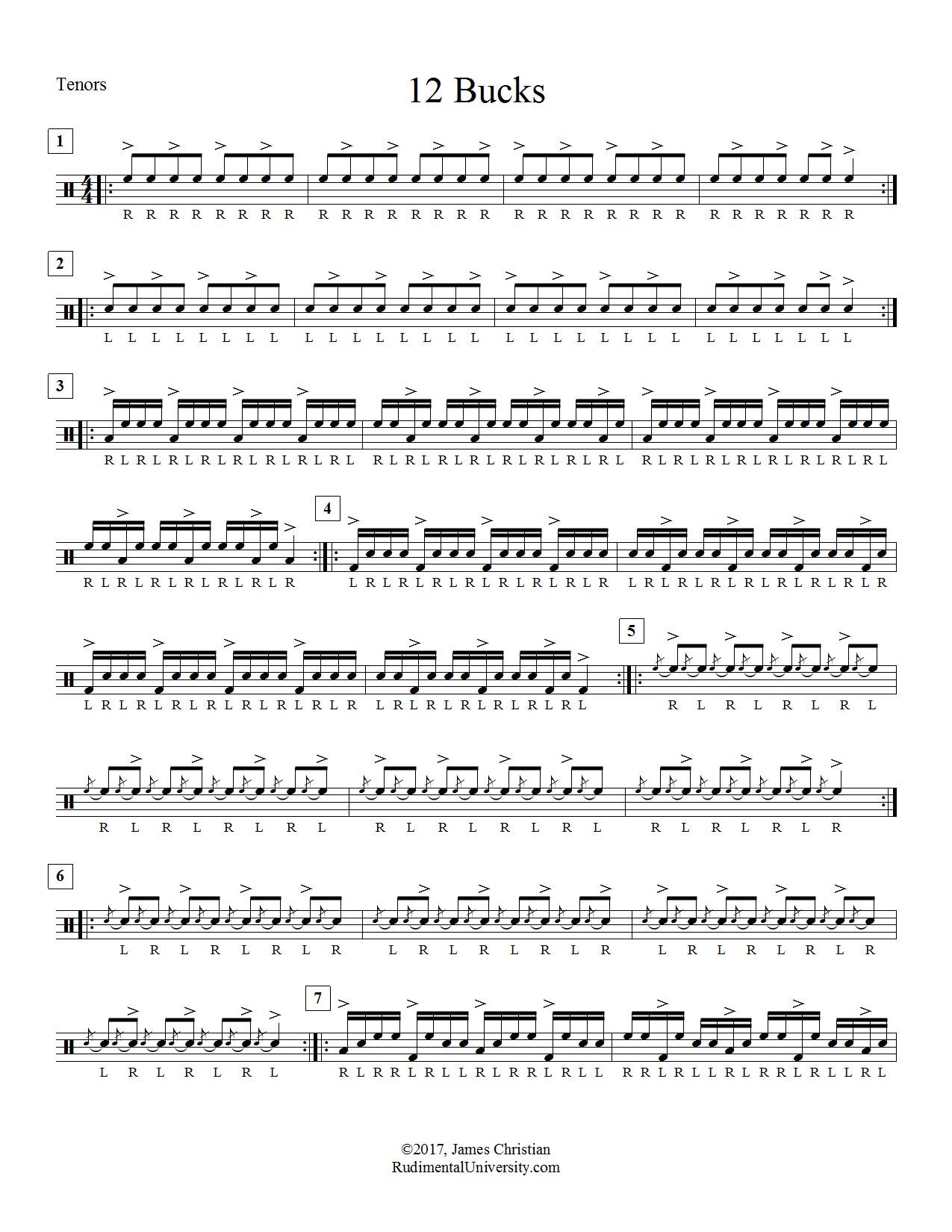
This exercise has gone through many tweaks and additions over the years.  In its current version, I think it’s a great tool in the arsenal of any percussionist.  When I first encountered this exercise, the first four sections were taught to me and the other students at Princeton High School (Princeton, Texas) by Rick Beckham.  This covered the accented 8th notes off the right hand and left hand, plus the accented 16th notes off the right hand and left hand.  He later added the next four sections (8th note flams leading with the right and left, plus the accented paradiddle patterns leading with the right and left).

The four main patterns—8th notes, 16th notes, flams, and paradiddles—are great for developing the control needed to distinguish accent and tap heights.  I have used this core exercise with several different drum lines, and it has been quite effective.

Over time, I decided to expand the exercise.  In personal practice, I used the basic accent structure on a number of different rudimental patterns.  When teaching it to a full drum line, I decided that I wanted to write a mallet part that went through the circle of fifths, covering all 12 major keys.*  I also wanted a bass drum part that worked split 16th note triplets and 32nd notes.  So I picked two of my favorite rudimental patterns that worked with that rhythmic structure to add sections 9-10 and 11-12.  In short, this exercise has something really useful for every section.

Since 12 sections are covered by going through the circle of fifths and the snare drum part is similar to the standard “Bucks” exercise, I decided to call the exercise “12 Bucks.”  Here is the breakdown of the skills required for snare drum and tenors:

  • Sections 1-2:  One-handed accented 8th notes.  Focus on maintaining a clear distinction between accents and taps.  Keep your taps low and controlled.  Make sure your accents are strong, not wimpy.  The tenor exercise is deliberately on one drum, so that the player can focus on the Y-axis motion and the fundamental accent/tap control.
  • Sections 3-4:  Alternating accented 16th notes.  This should follow the exact same technique as sections 1-2, except the opposite hand is now “filling in” the 16th notes.  All taps should be consistently at the same height and volume.  The tenors now move the accents to an adjacent drum.  Keep the accents strong and the taps consistently softer.
  • Sections 5-6:  Alternating 8th note flams.  These sections are excellent for focusing on the three heights of accents, taps, and grace notes.  The accents and taps should remain the same from the previous sections.  The additional grace notes should be softer and lower than the taps.  Once again, the tenors are deliberately on one drum in order to focus on the fundamentals of good flam technique.
  • Sections 7-8:  16th note paradiddles.  These patterns get a bit trickier.  Watch out for the sticking on measures 2 and 4!  The key to these section is that they should sound the same as the 16th notes in sections 3-4.  Do not let the “diddle” part of the paradiddles sound weaker or stronger than the singles you played in sections 3-4.
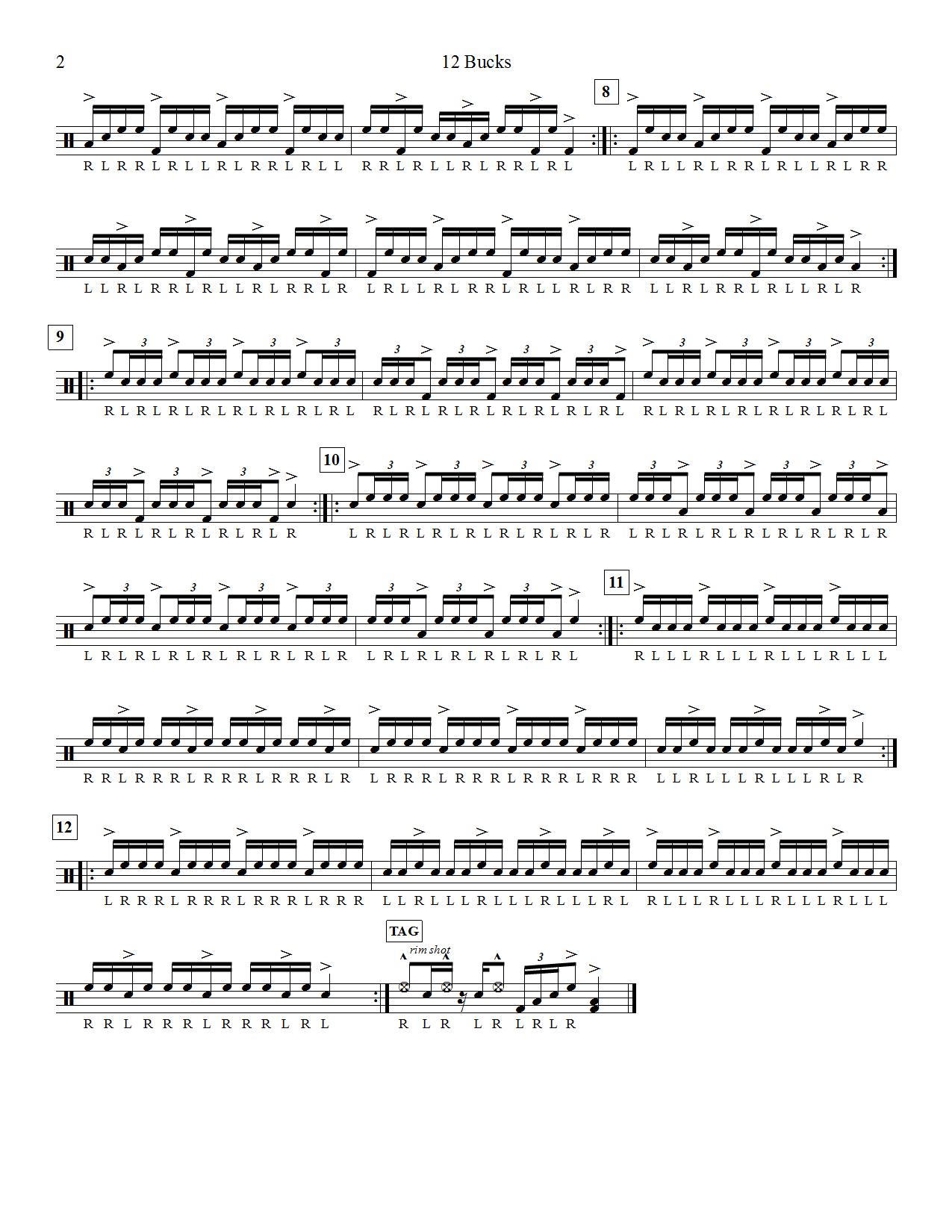
  • Sections 9-10:  Single stroke fours and single stroke sevens.  These rudimental patterns get your hands moving a bit quicker with the 16th note triplets.  They also require more precise timing focus.  Many drummers have a tendency to “cheat” the length of the initial 8th note by starting the triplet too soon.  Of course, you should practice the whole exercise with a metronome, but this section would especially benefit from doing so.
  • Sections 11-12:  “RLLL” quad groupings.  Once again, the 16th notes patterns should sound the same as sections 3-4 and 7-8.  Of course, these sections require more finger control in order to move each hand at the speed of 16th notes.
  • Tag ending:  A final syncopated measure to cap off everything!  Notice that the snare and tenor triplet rhythms are slightly different.  The tenors start on the downbeat, while the snares conclude on the upbeat.  Both parts should be played precisely in time in order to hear the tradeoff between sections.

Have fun learning these patterns.  Once you have them down, be adventurous and create your own variations!


*[Yes, I know there are technically 15 keys, but I’m not going to get into that debate right now.]

7 Reasons You Should Consider Entering a Solo Competition


Solo competitions can be an incredibly value experience for those who participate. Off the cuff, I decided to give a short talk about why I think everyone should consider competing in them.  Here are my seven reasons (plus two bonus thoughts!).  I think reason #7 is woefully neglected by performers and educators alike.

Here is a transcript of Read more “7 Reasons You Should Consider Entering a Solo Competition”

4-Mallet Keyboard Exercise: Double Lateral Chromatic Pattern

Click on the image to enlarge or click here to download in PDF format.

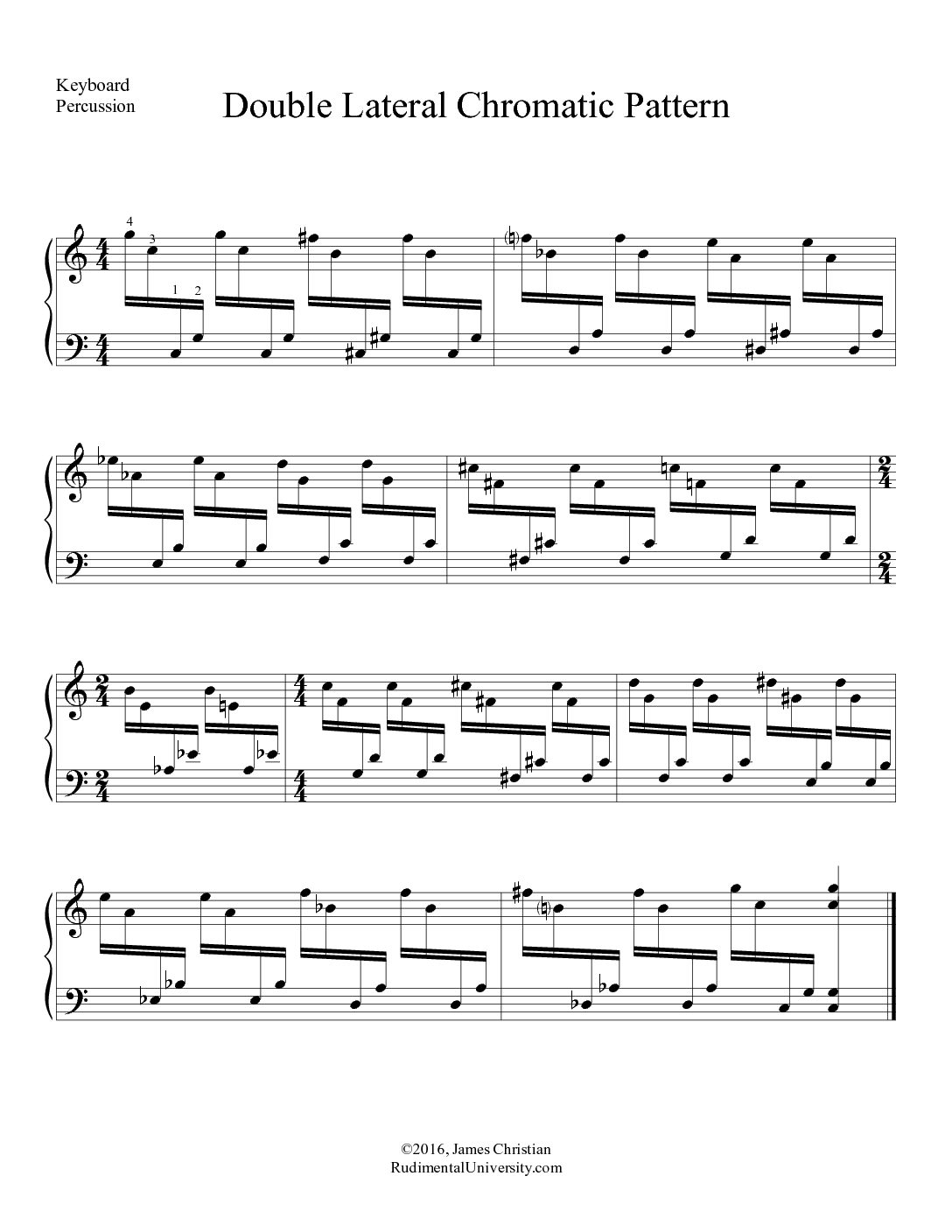
I live near the Dallas/Ft. Worth metroplex in Texas.  One of the most popular drum line contests in this area is the Plano Drum Line Competition, which is held every year in September.  In addition to offering the opportunity for dozens of drum lines to compete, Plano’s contest also features an individual & ensemble competition.  For each instrument, there is a “compulsory” that is to be performed before the contestant’s solo.  For snares and tenors, they must open and close a flam drag.  For timpani, they must perform “My Country, ‘Tis of Thee” on a maximum of three drums.  For four-mallet keyboard percussion, they are required to play the above double lateral exercise.

When I first saw this exercise, I really liked it.  I wondered how the contest hosts had decided to use it.  Well, this past year, I decided to start working through every exercise in Leigh Howard Stevens’ classic Method of Movement for Marimba.  (Of course, I had played from various sections before, but never in such a focused and goal-oriented way.  This time I was determined to play through the entire book.)  Lo and behold, this exercise is in the book’s section on double laterals.

I offer this bit of personal background info just to let you know why this exercise has stuck with me.  I’m glad it has.  It really is a great exercise for working double laterals across the keyboard.  I recommend starting it slowly until you feel confident in each position.  It is probably easiest to memorize the pattern.  Focus on striking the bars on the proper beating spots.  Also take care that each note resonates at an equal volume.  Don’t drop the second note of each lateral!

This exercise is obviously written for marimba, but it can also be played on xylophone and vibraphone.  For xylophone, simply play the exercise an octave higher.  For vibraphone, transpose the exercise up a minor seventh.  That is, take it up an octave, and then take it down a whole step, so that your first four notes are F, B-flat, B-flat, F.

Multi-Tenors Exercise: Paradiddle Pretzel

Click on the image to enlarge or click here to download in PDF format.

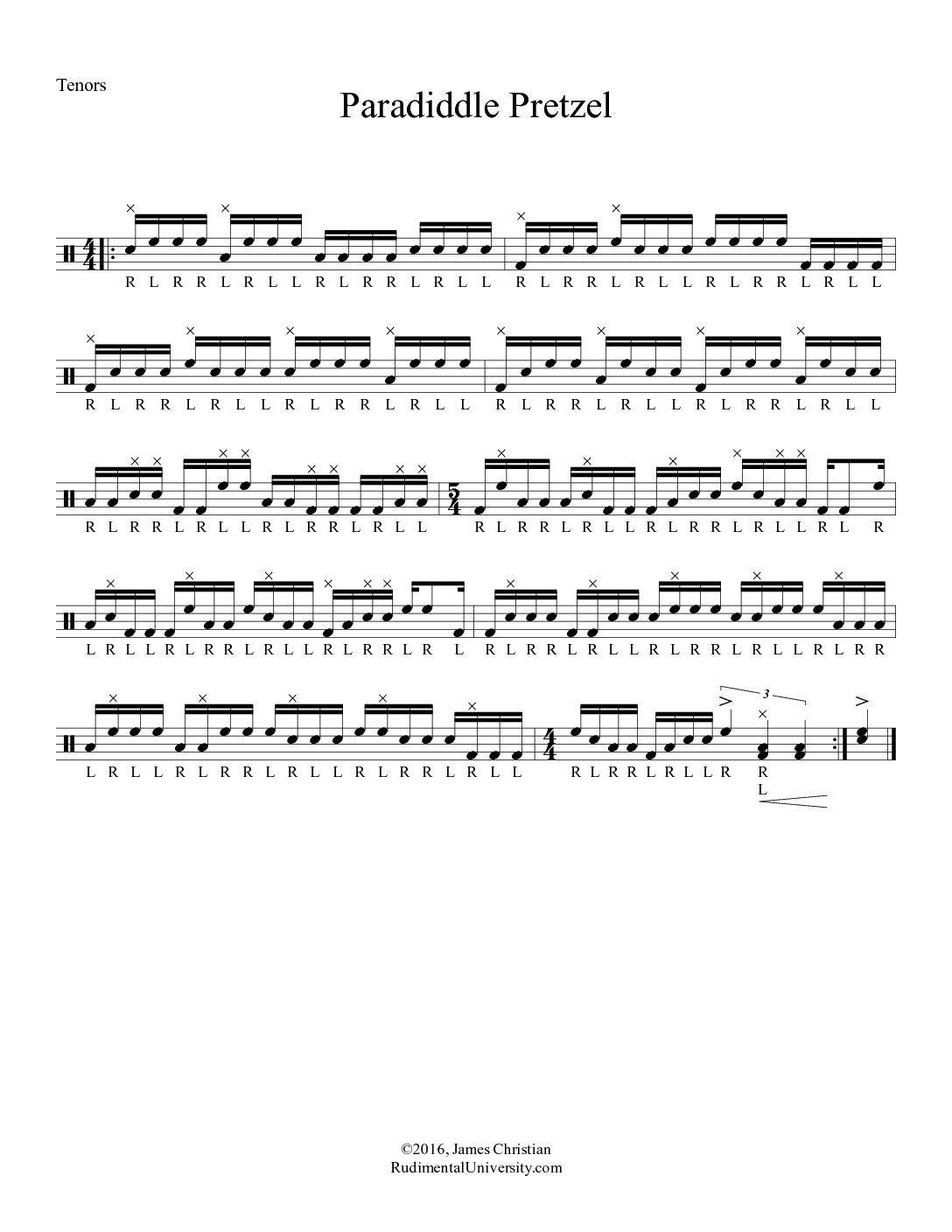
Here is a fun exercise that will put your arms in a pretzel.  I won’t claim that this exercise is the most essential (or even the most logical) exercise ever, but it covers a lot of paradiddle patterns around the tenors—and it’s just plain fun to play.  Some of the patterns are easier, and some of them are harder.  There is a continual contrast between standard patterns and not-so-standard patterns that makes the overall flow tricky to navigate.  Have fun with “Paradiddle Pretzel”!

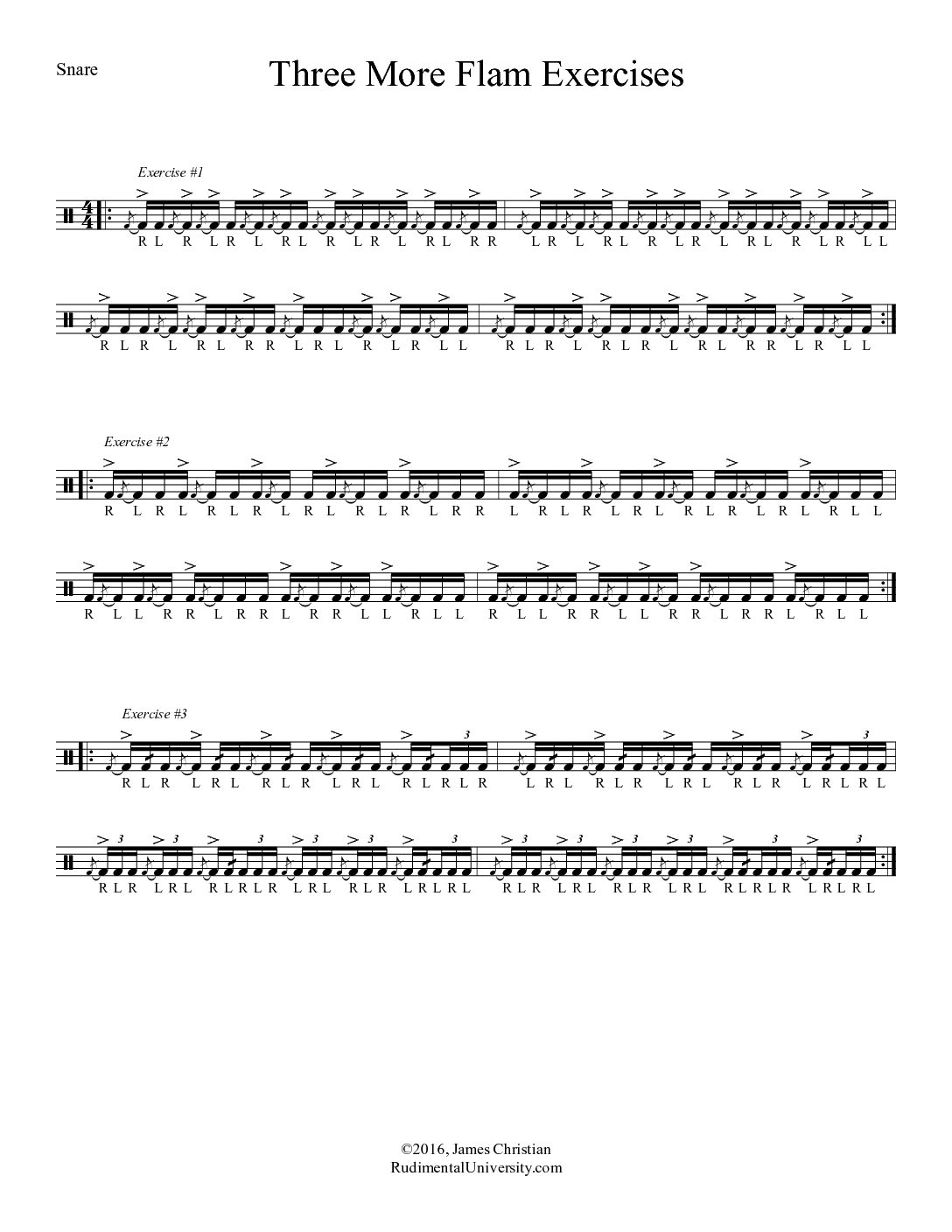
Snare Exercises: Three More Flam Exercises

Click on the image to enlarge or click here to download in PDF format.

Last time, we looked at three levels of flam exercises. Here are three more, but these are considerably more advanced.  They all follow the same accent “skeleton” from the previous set of flam exercises.

The first exercise utilizes rudiments often called triplet pataflaflas (though used as 16th notes in this exercise), flam tap paradiddles, and pataflaflas (that is, the regular kind).  A regular pataflafla is a group of four notes with a flam on the first and last note, and a triplet pataflafla is a group of three notes with a flam on the first and last note.  A flam tap paradiddle is a normal flam paradidle with a flam on the third note creating a flam tap on the “diddle” half of the paradiddle.

The second exercise is a true coordination challenge.  Essentially, the exercise is the same as the Level 2 exercise from last time, but the flams now follow immediately after the accent.  The rudiments all fall into the “unofficial hybrid” category, so their names vary from place to place.  Some names commonly given to these rudiments are dachudas (or tuchadas) and inverted tap flams.  (I’m unaware of a name for a paradiddle with a flam on the second note.  If you have a name for it, I’d love to hear it.  Please share it in the comments!)

The third exercise uses three fairly common rudiments—flam drags, flam ratamacues, and flam accents.  However, the way these rudiments are combined make it difficult to take this exercise very fast.  Only advanced players will be able to execute this exercise cleanly at tempos above the 132 bpm range.

Best wishes on learning these!  As always, make your accents strong, and keep your grace notes low and controlled!

Four Important Questions for the New Year

For the first few days of the New Year, you will undoubtedly see various individuals and organizations urging you to create new goals, set New Year’s resolutions, turn over a new leaf, and do whatever you can to make this year better than last year.  Of course, I know readers would be terribly disappointed if I didn’t give similar encouragements with regard to percussion. 🙂

However, I don’t want to offer blanket statements about overly ambitious goals that have little chance of getting accomplished.  I genuinely want you to Read more “Four Important Questions for the New Year”

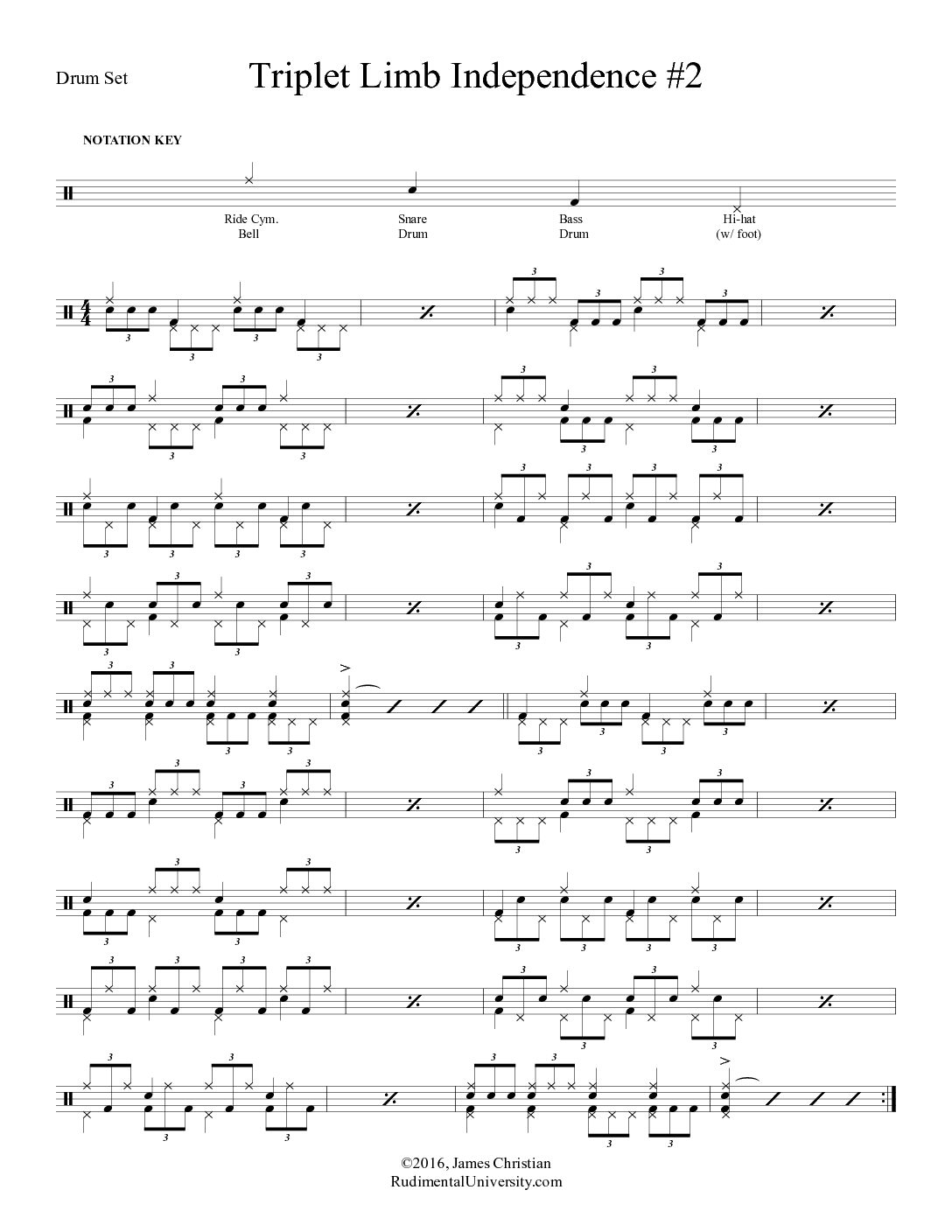
Drum Set Exercise: Triplet Limb Independence #2

Click on the image to enlarge or click here to download in PDF format.


It’s coordination time again!  In our last drum set exercise, we focused on different limb combinations with triplets.  This week, we take the same concept further and increase the coordinative complexity a bit.  (Note:  This assumes a traditional kit setup, in which the ride cymbal and bass drum are played with the right hand and right foot respectively, and the snare drum and hi-hat are played with the left hand and left foot respectively.  Adjust this exercise to work the same concepts according to your setup.)

Measures 1-2: triplets in left hand and left foot (3 notes each), quarter notes in right hand and right foot (lead with hand)

Measures 3-4: triplets in right hand and right foot (3 notes each), quarter notes in left hand and left foot (lead with hand)

Measures 5-6: triplets in left hand and left foot (3 notes each), quarter notes in right foot and right hand (lead with foot)

Measures 7-8: triplets in right hand and right foot (3 notes each), quarter notes in left foot and left hand (lead with foot)

Measures 9-12: repeats the previous patterns of measures 1-4 with triplets alternating single strokes between limbs

Measures 13-16: repeats measures 9-12, except the order of hand and foot is reversed on the single stroke triplets

Measures 17-18: a “tag” ending to wrap it up

Measures 19-36: the entire exercise repeats with the opposite side leading (right hand becomes left hand and vice versa, right foot becomes left foot and vice versa)

Between this exercise and the previous exercise, just about every combination is covered.  If you can play both exercises smoothly and consistently, your coordination will increase significantly.